Stefa’s servitude in the Anger household
Felix AustriaStefa’s servitude in the Anger household is more than a job: it is the structure through which she receives shelter and belonging, serves Adèle, and understands her own capacity to love. The household depends on her practical and emotional labor, but its members do not describe that dependence in the same way. For Stefa, service is an intimate form of devotion; for Adèle, it is also an education and a carefully maintained hierarchy. The tension between those meanings follows Stefa beyond the Anger home, even as her work eventually extends into another household.
Identity and Background
Stefa enters the Anger household as a poor Ruthenian orphan with little social standing. The doctor arranges for her to attend Queen Hedwig’s school for girls alongside Adèle, an opportunity she regards as an extraordinary act of care: he has already saved her life, given her a roof, and provided food and clothing, and he was under no obligation to ensure she learned to read or write. Yet Stefa’s own preference is to remain close to him at home, bringing him coffee and tending to the details of his work rather than joining the other pupils. Her schooling therefore sits beside, rather than displaces, the attachment and service that shape her place in the family.
That dependence acquires the force of an explicit charge when the dying Doctor Anger tells her that she and Adèle are like two trees with intertwined trunks and instructs her to serve Adèle. The remembered command becomes, for Stefa, a daily rule: she interprets each task as a kind of prayer for Adèle. The relationship is thus rooted not only in affection or household custom but also in a promise made to the man who had provided for her. Stefa’s sense of choice is narrowed by gratitude, loyalty, and the conviction that Adèle cannot manage without her.
The Work of Service
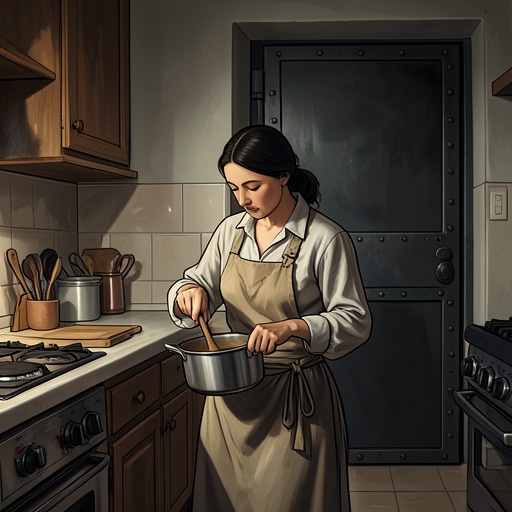
Stefa’s duties span nearly every part of domestic life. She prepares meals, cleans, shops for provisions, and carries Petro’s lunch to whichever place he is working, whether the cathedral or the prison chapel. She also attends to Adèle’s health and appearance, including giving her a therapeutic massage and preparing apples pierced with iron nails in the hope of easing her anemia. When the roof leaks, Stefa changes the buckets catching rainwater while continuing the cooking, cleaning, errands, and care that the household requires. The work does not pause because another task has become urgent; the household’s order rests on her moving from one need to the next.
Her care for Adèle is particularly detailed. During the couple’s honeymoon in Krakow, Budapest, and Vienna, Adèle is afraid to travel without her, and Petro agrees only after several nights of tears. Throughout the trip, Stefa arranges for Adèle to receive soft-boiled eggs, seeks the freshest cream for her coffee, dresses and combs her, and prepares her clothes. She also packs the scented salts and oils for Adèle’s bath and the herbal preparations used to rub her body. The journey makes visible how much of Adèle’s comfort and presentation is produced by work that can be overlooked precisely because it is so constant.
Service also takes the form of staging a household’s welcome. Before guests arrive, Stefa dresses Adèle in layers of fine clothing, arranges her hair, and fastens a chrome-and-glass comb shaped like a dragonfly on a cherry branch. She then lays out a carefully provisioned table with fruit, cakes, compotes, salads, polished candleholders, and the full assortment of plates, cutlery, glasses, and condiments. These preparations express Stefa’s pride in Adèle and her wish that everyone recognize what she sees as her treasure. Her labor is practical, but it also shapes the social scene in which Adèle is admired.
Affection, Training, and Hierarchy
The household’s account of Stefa’s position becomes especially clear when Ernest Thorn praises her cooking and diligence. Adèle answers that a good servant is not something one simply gets lucky enough to find: servants must be educated, raised, and instructed. She describes the process as a form of training, yet insists that it succeeds only through humane conduct, friendly understanding, and closeness. Her father began this education when Stefa was a baby, she says, and she continued it. In Adèle’s formulation, affection does not abolish the boundary between mistress and servant; it is the means by which that boundary is preserved without open harshness.
Adèle’s speech is also a pointed public definition of their relationship. She presents Stefa’s years of labor as the outcome of a long household project, and the praise of her cooking becomes an occasion to assert the mistress’s authority over the servant’s formation. Stefa, standing obediently at the door, is praised for her skill while remaining outside the conversation as its subject. The scene exposes the gap between being valued and being treated as an equal: Adèle can sincerely take pride in Stefa while describing that pride through the language of instruction and disciplined service.
Stefa’s own response to conflict shows how deeply that hierarchy has entered her conduct. She recalls earlier disputes with Adèle as prolonged cycles of accusation, anger, tears, and attempted reconciliation. Their quarrels could resume in the middle of the night even after they had seemed to make peace. In one remembered incident, Adèle called her a slave while playing with friends; in another, she accused her of stealing the doctor’s watch. Stefa says she has learned to swallow her bitterness and continue her tasks, because she is not there to establish justice but to make Adèle’s life easier. Service thus includes emotional self-management: resentment is not resolved so much as contained so that the work and the attachment can continue.
Food, Care, and Recognition
Cooking is among the clearest ways Stefa gives form to her affection. When she cannot find peace, she works in the kitchen, passing, reducing, roasting, frying, and stuffing; cooking becomes a practice through which she can return to life and attend to others. She describes herself as taking on the qualities of the food she serves: fragrant, savory, sharp, delicate, and nourishing. Her giving is so complete that she imagines offering herself to the last drop. If people refuse to eat, she experiences the refusal as evidence that they do not want or value her. Food therefore carries both care for its recipients and Stefa’s need for that care to be accepted.
At Adèle’s birthday gathering, the guests’ praise of the food makes Stefa’s skill conspicuous, but her own account of the occasion stresses the limits of recognition. Once the guests have eaten, she returns to the role she names for herself: prepare, cook, bake, wash, clean, mend, endure, and remain silent. Petro, by contrast, takes the loaded tray from her hands and helps carry it into the kitchen. He tells her that without her the celebration would not have been possible and that she is part of their family. Stefa lowers her eyes, dismisses the remark as something he says because he has drunk too much, and returns to her work. His gratitude offers a different name for her place in the home, but it does not erase the servant identity under which she continues to labor.
Change and Significance
Stefa’s position eventually changes in practical scope. She reports that she is now working in two houses, keeping both in order and clean and cooking in both, and finds that her strength has increased rather than failed. The change does not mean that domestic service has ceased to organize her life; instead, the labor that once centered on the Anger household now extends beyond it. When Josef tells her that he cannot allow her to work for him in addition to her work for her existing masters without compensation, she collapses onto a chair. His insistence that work should be paid brings the economic value of her labor into direct view, in contrast with the language of familial closeness and lifelong training that has framed her service to the Angers.
The story keeps these interpretations in tension rather than resolving them into a simple judgment. Stefa’s care is loving, skilled, and chosen in the immediate sense that she repeatedly acts through it; it is also shaped by poverty, dependency, a deathbed obligation, and a household order in which affection can coexist with a fixed servant’s place. Her work makes the Anger home function, feeds its guests, sustains Adèle’s daily life, and creates the very intimacy the household celebrates. Yet Stefa’s own words reveal the cost of a bond in which being indispensable does not necessarily mean being free to leave. The servitude is therefore both the medium of her attachment and the condition that limits how she can imagine herself apart from it.